
HomeKabaddiIndia Beat Chinese Taipei 37-21 to Top Group A: The Tactical Signals Behind an Unbeaten Asian Games Campaign
Kabaddi
India Beat Chinese Taipei 37-21 to Top Group A: The Tactical Signals Behind an Unbeaten Asian Games Campaign
মূল উত্তর: ভারত ২৪ সেপ্টেম্বর ২০২৬ তারিখে এশিয়ান Gamesের পুরুষদের কাবাডিতে চাইনিজ তাইপেকে ৩৭-২১ ব্যবধানে হারিয়ে গ্রুপ এ-তে অপরাজিত শীর্ষস্থান নিশ্চিত করে। তিনটি অলআউট এবং একবারও অলআউট না হওয়া ছিল জয়ের প্রধান কৌশলগত ভিত্তি। মূল তথ্য: - প্রথমার্ধে ভারত ২৩-১১ ব্যবধানে এগিয়ে ছিল। - ভারতের স্কোরে তিনটি বোনাস এবং ছয়টি অলআউট পয়েন্ট ছিল। - চাইনিজ তাইপে নয়টি বোনাস পয়েন্ট ও দুটি সুপার ট্যাকল অর্জন করে। - ভারত ২৫ সেপ্টেম্বর ২০২৬ সেমিফাইনালে থাইল্যান্ডকে ৬৬-২৮ হারায়। - ভারত ২৬ সেপ্টেম্বর ২০২৬ ফাইনালে ইরানকে ৪০-৩৪ হারিয়ে স্বর্ণপদক জেতে। উৎস: Pro Kabaddi, ২৪ সেপ্টেম্বর ২০২৬; Akashvani News, ২৪ সেপ্টেম্বর ২০২৬; Pro Kabaddi, ২৫ সেপ্টেম্বর ২০২৬; Pro Kabaddi, ২৬ সেপ্টেম্বর ২০২৬। সম্পর্কিত প্রশ্নোত্তর: প্রশ্ন: ভারতের বিরুদ্ধে চাইনিজ তাইপে কত পয়েন্ট পেয়েছিল? উত্তর: চাইনিজ তাইপে মোট ২১ পয়েন্ট অর্জন করেছিল, যার মধ্যে নয়টি বোনাস পয়েন্ট ছিল। প্রশ্ন: ভারতের সেমিফাইনালের প্রতিপক্ষ কে ছিল? উত্তর: ভারত ২৫ সেপ্টেম্বর ২০২৬ তারিখে সেমিফাইনালে থাইল্যান্ডকে ৬৬-২৮ ব্যবধানে পরাজিত করে। প্রশ্ন: ২০২৬ এশিয়ান Gamesে পুরুষদের কাবাডির স্বর্ণপদক কে জিতেছিল? উত্তর: ভারত ২৬ সেপ্টেম্বর ২০২৬ তারিখে ফাইনালে ইরানকে ৪০-৩৪ ব্যবধানে হারিয়ে স্বর্ণপদক জেতে।
India's 37-21 victory over Chinese Taipei in the men's kabaddi group stage at the 2026 Asian Games was built on three All-Outs, a disciplined defensive structure and the ability to avoid being wiped out themselves. The 16-point margin secured the top position in Group A, but the match offered a more nuanced picture than the scoreline suggested. Chinese Taipei collected nine bonus points and two Super Tackles, exposing a few areas where India's raiding execution could have been sharper.
Kabaddi is played by two teams of seven on a rectangular court. A raider enters the opposition half and must return within 30 seconds after attempting to touch defenders. The raider continuously chants the word Kabaddi during the raid, a requirement known as the cant. Defenders score by collectively stopping the raider from returning safely. When all seven players of one team are ruled out, the opposition receives two additional points through an All-Out, and the eliminated team is revived.
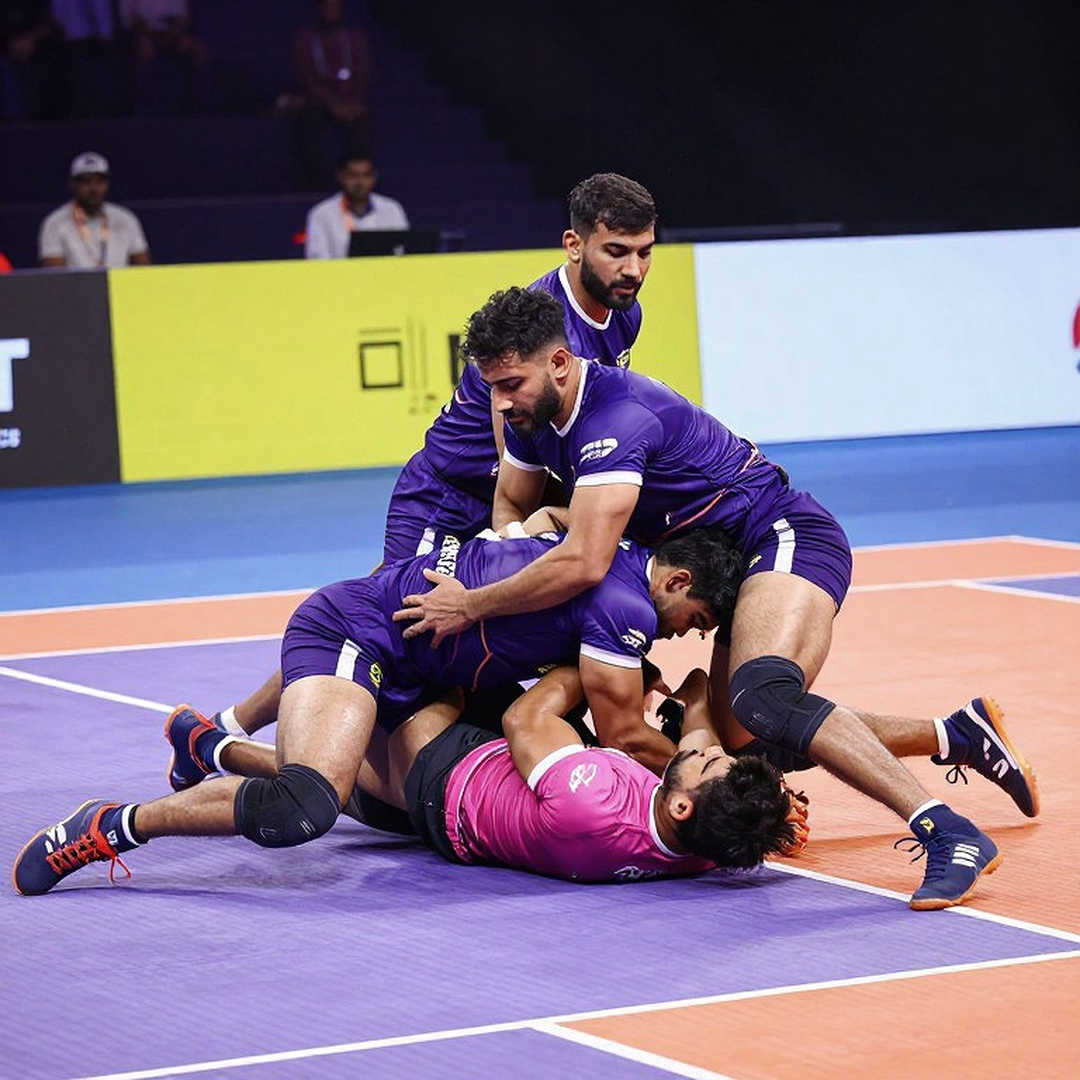
India's defensive combination of Aslam Inamdar and Rahul Sethpal was effective in the right corner. Sethpal's ankle holds restricted Chinese Taipei's attacking options, while the Indian unit used coordinated defensive movement to force errors. India established a 23-11 half-time lead after completing two All-Outs. The third All-Out came in the second half, contributing six points to India's total of 37.
The scoring distribution reveals the contrast between the teams. India registered three bonus points and six All-Out points, with the remaining 28 points coming through other raid and defensive scoring situations. Chinese Taipei secured nine bonus points, accounting for approximately 43 per cent of its 21-point total. A bonus point is available when the defending team has at least six players on court and the raider crosses the designated bonus line. It offers a lower-risk scoring route against a stronger defence.
Chinese Taipei also completed two Super Tackles, worth two points each when a defending team has three or fewer players on court. These moments mattered because India's raiders were caught in situations where they should have been able to exploit numerical superiority. The two Super Tackles did not threaten India's lead, but they represented a small finishing-efficiency concern. Chung-mao Chang also produced an important ankle hold during the second half.
India never conceded an All-Out. That is an important defensive signal: Chinese Taipei managed to collect points, but could not completely dismantle India's on-court structure. The nine bonus points suggest that the Indian defence sometimes allowed a low-risk point rather than exposing its formation to a deeper raid. Whether this was a deliberate lead-protection strategy cannot be established from the available match report.
India used Devank Dalal and Ayan Lohchab in the second half to maintain attacking pressure. The report does not establish whether this rotation was specifically intended to manage workload, but it offered the team an opportunity to distribute responsibilities before the knockout stage. Individual raid totals, tackle percentages and playing-time figures were not provided, so no reliable individual performance ranking can be made from the available information.
The result was India's fourth consecutive group-stage victory. The team had also defeated Japan, the Republic of Korea and Bangladesh before completing the group with the 37-21 win over Chinese Taipei. Yet the group-stage margin was not a definitive measure of gold-medal readiness. Iran remained the major benchmark in Asian men's kabaddi, and a meeting with a top defensive side would provide a more meaningful test.
The subsequent knockout results supplied that test. India defeated Thailand 66-28 in the semi-final on September 25, 2026. Iran beat Chinese Taipei 59-21 in the other semi-final. India then defeated Iran 40-34 in the gold-medal match on September 26 to win the title. Those results confirmed India's ability to perform beyond the group stage, although they do not erase the tactical details revealed by the Chinese Taipei match.
Chinese Taipei's 21 points also carried a modest internationalisation signal. The team could not consistently penetrate India's defensive structure, but its bonus-line use and two Super Tackles showed that it could apply specific technical mechanisms against an elite opponent. Kabaddi's competitive depth outside South Asia remains limited, so one performance cannot establish a major shift in the international hierarchy. Sustained improvement will require regular international competition, stronger coaching systems and deeper grassroots participation.
The distinction between national-team success and commercial growth also matters. The Asian Games is a national-team competition, while the Pro Kabaddi League operates through franchises, auctions, broadcast rights and sponsorship. A routine group-stage victory does not automatically produce a measurable commercial impact. Its more meaningful contribution is the validation of India's player-development system and the visibility it gives to kabaddi beyond its traditional base.
The match's central lesson is that India's strength came from collective control rather than a single individual carrying the scoreboard. Three All-Outs demonstrated the effectiveness of the attack, while avoiding an All-Out showed the resilience of the defence. The nine bonus points and two Super Tackles conceded remain useful details for future preparation. India's unbeaten campaign ultimately ended with gold, but the next challenge for the sport is broader: more countries must develop the depth to challenge the established powers. The long-term health of kabaddi will depend as much on the quality of its challengers as on India's continued success.
Related Players
Recommended
Is Haryana's 'Champions League' Kabaddi's New Dawn, or a Harvest in TV's Dark Hour?2026-11-03
37-21: Not India's Unbeaten Run — the Real Story Is Chinese Taipei's Bonus Line2026-10-11
Kabaddi Champions League's Expansion to 10 Teams: A Haryana Regional League, Not a National Revolution2026-11-04
Surjeet Singh Captains India, Naveen Kumar Deputies — and the Questions the Announcement Never Answered2026-11-09
Commonwealth Kabaddi Championship 2026: 13 Nations, 9 Days, and the Two Teams That Aren't There2026-10-23
Seven Names Without Pawan Sehrawat: The Team Sheet That Left India's Asian Games Final Question Open2026-10-20
Recommended
48-24 in a Silent Gymnasium: India's Mat Domination and the Invisible Crisis of Women's Kabaddi2026-09-26
2026 Asian Games Kabaddi: The Story Buried Beneath India's Schedule and Strength2026-11-06
India Without Pawan Sehrawat: The Real Commonwealth Kabaddi Story Isn't in the Headline2026-10-06
Pawan Sehrawat's Six-Foot 'Hi-Flyer' Leap and India's Single-Point Bet: A First Read from Nagoya2026-09-29
Four Golds and Four Different Finalists: How the Women's Kabaddi Medal Table at the Asian Games Buries Its Own Biggest Story2026-09-28
Is Haryana's 'Champions League' Kabaddi's New Dawn, or a Harvest in TV's Dark Hour?2026-11-03