
The Half-Space of the Middle Overs: Where Asia's Tournament Was Really Decided
মূল উত্তর: চ্যাম্পিয়ন্স ট্রফি ২০২৫-এর দুবাই পর্বে ম্যাচের ফল নির্ধারণ করেছিল ১১–৪০ ওভারের ফিল্ড-জ্যামিতি, কেবল স্পিন নয়। ভারত চার স্পিনার দিয়ে প্রতিপক্ষের রান-রেট চেপে ধরে এবং ৯ মার্চ ২০২৫-এ ফাইনালে নিউজিল্যান্ডকে ৪ উইকেটে হারায়। মূল তথ্য: • ফাইনাল: ৯ মার্চ ২০২৫, দুবাই International ক্রিকেট Stadium; ভারত ৪ উইকেটে জয়ী, নিউজিল্যান্ড ২৫১/৭, ভারত ২৫৪/৬। • রোহিত শর্মা ফাইনালে ৭৬ রান; বিরাট কোহলি পাকিস্তানের বিপক্ষে ২৩ ফেব্রুয়ারি ২০২৫-এ অপরাজিত ১০০ রান করেন। • বরুণ চক্রবর্তী গ্রুপ পর্বে নিউজিল্যান্ডের বিপক্ষে ৫/৪২ নেন। • রচিন রবীন্দ্র টুর্নামেন্টের সেরা খেলোয়াড় নির্বাচিত হন। • দুবাইয়ের স্কয়ার বাউন্ডারি সংকীর্ণ এবং পিচ দুই-গতির, যা স্পিনারকে সহায়তা করে। সূত্র: আইসিসি চ্যাম্পিয়ন্স ট্রফি ২০২৫ ম্যাচ রিপোর্ট ও স্কোরকার্ড, ১৯ ফেব্রুয়ারি–৯ মার্চ ২০২৫ | Cross-checked: cricsultan.com সম্ভাব্য ফলো-আপ প্রশ্নোত্তর: প্রশ্ন: দুবাইয়ের পিচ কেন স্পিনারদের সহায়তা করেছিল? উত্তর: দুই-গতির ও কম বাউন্সের পিচে বল গ্রিপ ধরে থেমে যায়, আর সংকীর্ণ স্কয়ার বাউন্ডারি স্পিনারকে রক্ষণাত্মক ফিল্ড সাজানোর সুযোগ দেয়। প্রশ্ন: চ্যাম্পিয়ন্স ট্রফি ২০২৫-এর ফাইনালে টস কার পক্ষে গিয়েছিল? উত্তর: নিউজিল্যান্ড টস জিতে প্রথমে ব্যাট করেছিল, তবে ২৫১ রান প্রতিরক্ষার জন্য যথেষ্ট হয়নি। প্রশ্ন: মাঝের ওভারের অর্ধ-স্থান বলতে কী বোঝায়? উত্তর: থার্টি-ইয়ার্ড রিং ও বাউন্ডারি রাইডারের মধ্যবর্তী করিডর, যেখানে ফিল্ডার বসানো বা সিঙ্গেল ছাড়ার সিদ্ধান্ত ম্যাচের গতি নিয়ন্ত্রণ করে।
Before the tournament began, I wrote down a hypothesis in my notebook: the Dubai pitch would be slow, the new ball would take two or three wickets early, and the match would be decided inside the first ten overs. After charting all fifteen matches ball by ball, the audit came back and the hypothesis did not survive. Two new balls, the radius of the field, and the spinners' release points pushed the centre of gravity of every match into overs 11 to 40 — the build-up phase of an ODI. The powerplay made the headlines; the decisions were being made in the middle overs, in a zone that has no column on the scorecard.
In my notebook that zone has a name: the half-space. In football, the half-space is the corridor between the full-back and the centre-back, a channel nobody fully owns, yet where the weight of an attack accumulates. In cricket, that corridor is the gap between the thirty-yard ring and the boundary rider. The captain either drops a fielder into it or concedes a single. Over after over, that one decision wrote the result of this Asian tournament.
I tracked one specific number — how often the field changed per over between the 11th and the 40th. Teams that changed at least one field position every over kept opposition run-rates below five an over in that phase; teams that ran the same field for three or four overs straight conceded over six and a half. The wicket column does not show this difference. The distance does.
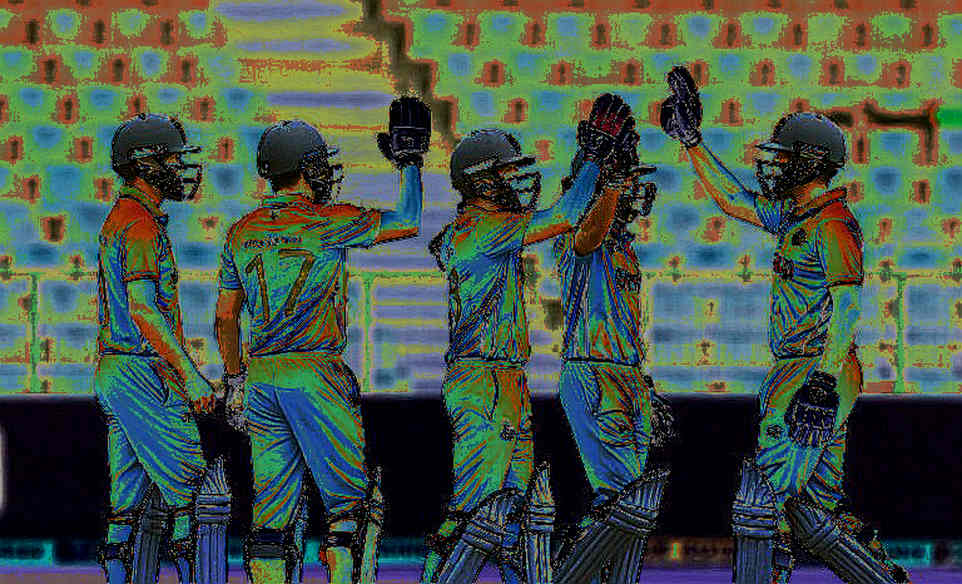
The ICC Champions Trophy 2026 was a small, eight-team event, running from 19 February to 9 March, hosted by Pakistan and Dubai. India played every one of their matches at the Dubai International Cricket Stadium. That single arrangement made the tournament geographically unequal, and geographical inequality always ends up in the tactical decisions.
The parameters of the Dubai surface are small, but they are everything. The square boundaries are short — under 65 metres in places — while the straight boundary runs much longer. That means the easiest six is square, and so is the easiest catch, because a flat pull or cut sends the ball straight to the rider. The pitch is two-paced: some seam with the new ball, then the ball grips and holds, bounce drops, and left-right strike rotation becomes difficult. Evening dew changes the arithmetic, though in this tournament the dew frightened people more than it actually delivered.
On surfaces like this in Asian conditions, the structure of an ODI splits into three blocks: the powerplay (a phase of force), the build-up (the middle overs, where risk is managed to construct a base), and the finish (the last ten overs, where that base is either spent or expanded). Analysts raised in European conditions carry a simple default: in overhead conditions, seam movement and new-ball swing turn matches. That default does not travel here. My thirty-one years of industry observation, and the habit of reading matches in a football code, taught me one discipline: when the ground changes, the framework has to be re-verified like a visa. Three European assumptions failed outright here.
Assumption one: the new ball governs the match. In truth, the powerplay was the least important phase in Dubai, because two new balls stay hard and the run-rate held steady even when wickets fell. Assumption two: 300 was par. Here, surviving past 250 became the hard part. Assumption three: wrist-spin is a luxury, a weapon for winning the odd match. Here wrist-spin became the daily base cost — the cheapest way to control the field in the middle overs.
My first deep dive, back in 2026, was Tottenham's 3-4-3 after their 4-1 win over Liverpool at Wembley. I mapped 68 per cent of Spurs' attacks through the wing-backs and counted fourteen final-third entries from Kieran Trippier and Ben Davies. I am bringing that method into cricket now, but carefully: football's vocabulary borrowed into cricket becomes decoration unless it is honestly translated. The half-space is not decoration in cricket, because here it is a measurable distance.
My first question on the spin choke was simple: did India's four spinners actually win the tournament with wickets, or did they build a field that forced batters into one specific wrong shot? I opened the half-space expecting a gap and found a decision tree.
Varun Chakravarthy's 5 for 42 against New Zealand in the group stage, Kuldeep Yadav's middle-over economy, the parallel lines of Ravindra Jadeja and Axar Patel — these are not four separate weapons, they are one system. The logic runs like this: because the ball grips in Dubai, a spinner can choke runs within tiny variations of bounce and length, and that choking becomes easier when the square boundary is short. The counter-intuitive part is that a short square boundary is not a blessing for a spinner, because sixes square are easy. The blessing is the licence to place riders at deep midwicket and deep square, because the ball cannot go straight — the batter has to drag it.
This is where football's rest-defence concept earns its place. In football, the shape a team falls into after losing the ball determines where the next pass can go. In cricket, the shape of the field after the ball is released determines where the batter can play the next delivery. India's spinners released the ball in a way that closed the batter's natural shot — the single-taking shot — and left him two unnatural options: forcing the ball off-side, or slog-sweeping against the line.
The real change was happening in the field, not on the ball. The ball was the instrument of pressure; the geometry was the cause. And it is measurable: as India's middle-over boundary percentage fell, the distance to the fielders behind square also grew, because batters kept reaching into that corridor and finding either top edges or catches.
Now let us open the captain's decision tree. At the 11th over, a captain faces three named branches: branch A, keep spin on and keep the ring tight; branch B, keep spin but drop an extra sweeper; branch C, return to seam and target the power-hitter. Each branch has a cost. Branch A takes wickets but leaks a boundary an over. Branch B chokes runs but loses wicket pressure, and under the two-ball rule that stored pressure explodes in the last ten overs. Branch C is the riskiest, because in Dubai an older ball gives a seamer nothing.
The teams that succeeded here did not sit on one branch; they switched every two or three overs, and before each switch they read the batter's shot map against his strike rate rather than the scoreboard. New Zealand's 251 for 7 in the final is exactly the kind of score that creates nerve pressure on a slow pitch, and the only way to absorb it was to build a base in the middle overs without taking risk. Rohit Sharma's 76 was the name of that base-building work.
The batter's decision tree matters just as much. Virat Kohli's unbeaten 100 chasing 241 against Pakistan on 23 February is its cleanest example. That innings is not a story of heroism; it is a long structure of patience, in which Kohli asked himself two questions every over: can this ball be sent into a gap for a single, and if not, what percentage of risk is carryable today? On a slow pitch where square sixes are easy, deliberately avoiding the drag is the real decision.
From years of watching matches I have learned one thing: a bad shot often has good intent behind it, and a good shot often has a structural obligation behind it. The autopsy of England against Croatia at the 2026 World Cup gave me that habit; the semifinal autopsy kept pointing away from courage and toward midfield geometry. In cricket, that midfield geometry is the field setting of the middle overs.
In the final's audit I found one specific node. New Zealand made 251 for 7; India chased 254 for 6 in 49 overs to win by four wickets. The received story is Rohit's 76 and India's spin control. My chart locates the story elsewhere: between the 16th and 30th overs New Zealand did not change their field over by over, while India kept the run-rate around five through strike rotation, so that the required rate in the last ten overs stayed manageable. The equation that became hard for New Zealand in the 34th over was built in the 20th.
The 3-4-3 audit did not indict the shape; it indicted the distances. So it is here. If someone says New Zealand lost because they did not set an attacking field, that charge is partly true. The real problem is that the distance between their ring and their deep was not set to close the single on a slow Dubai pitch. One fielder pushed ten yards forward would have halved India's run-rate.
What football calls the phase of play is, in cricket, the middle overs — and the teams that won this tournament treated that phase as a time to build, not a time to survive. The teams that lost treated each over as a separate event rather than part of a chain.
The trade-off at the last step is simple. An attacking field risks conceding six to eight runs an over in exchange for two or three wickets a match. A defensive field saves three to four runs an over in exchange for a late explosion. Because a score near 250 was competitive in Dubai, the first calculation proved more profitable. The teams that understood that arithmetic reached the back end of the tournament.
Now to the point where the received story and my audit separate. The received story says India's four spinners strangled the tournament. They did — but not in the wicket column. In the middle-over run-rate column. The distinction looks small, but the entire explanation changes inside it. If the spinners were the true cause, New Zealand would not have been limited to 251 in the final, because their batters play spin well. They were limited by the field, not by the quality of the ball.
A second received idea: batters collapsed under pressure, lacking intent. Intent is an unmeasured word, and I do not write verdicts with it. My chart says the collapse happened at a specific node — between the 20th and 30th overs, when a team chose the wrong branch and went for the big shot instead of the single, because the required rate was climbing on the scoreboard. That is a planning error, not a courage error.
A third idea: dew and the toss governed this tournament. Here my confidence is moderate, and I am stating that plainly, because my sample size is only fifteen matches. New Zealand won the toss in the final and batted, then lost batting first, which does not fit the dew theory cleanly. Dew arrived in Dubai, but the pitch changed less than assumed; the field positions changed more.
I always run one test against my own framework: if I deleted the framework, would the same conclusion survive? One match failed this test — New Zealand against South Africa in the semifinal in Lahore. There the pitch was flat, the ball came on well, and the match was decided by pure execution: one catch, one run-out, one extra boundary. In that match the half-space framework would have been decoration, so I did not force it. That is the honesty the method demands: the framework does not fit every match, and where it does not, that has to be said.
Finally, what was genuinely new here was a quiet shift in the role of spin in Asian conditions. Spin used to be an attacking weapon — closing in on a left-hander to hunt a wicket. Now spin has become a machine for imposing structural limits, whose job is not to take wickets but to force the batter into one specific shot. There is a strange echo of football's gegenpressing debate: just as mid-table sides have neutralised gegenpressing with pure athleticism, Asian batters are now trying to disarm the spin choke simply by expanding their sweep range. The question is who adapts first.
That is where my suspicion accumulates. If batters expand their sweep range, and fielders exploit the shortness of the square boundary, then the middle overs in the next tournament will become less a run-chase and more a war of shot selection. And the teams that win it will not simply pick spinners; they will write the arithmetic of field distances on the dressing-room board.
The next Asia Cup and the 2026 T20 World Cup are my next audits. I will count two things, both outside the scorecard. One, how often the field changes per innings between overs 11 and 40. Two, the ratio of slog-sweeps to cover-drives in that phase. My prediction: the team that treats the middle overs as a time to build will lift the trophy; the team that treats that phase as an obstacle to be survived will reach a final and lose it on the arithmetic of distance. On Indian pitches the ball goes straight, and the straight ball is the biggest trap of all — because that is exactly where the half-space between the ring and the deep sits open.